PBF Energy Inc. Files 2023 Annual Report on Form 10-K
Ticker: PBF · Form: 10-K · Filed: Feb 15, 2024 · CIK: 1534504
| Field | Detail |
|---|---|
| Company | Pbf Energy Inc. (PBF) |
| Form Type | 10-K |
| Filed Date | Feb 15, 2024 |
| Risk Level | medium |
| Pages | 15 |
| Reading Time | 19 min |
| Key Dollar Amounts | $1.69 b, $845.6 million, $431.0 million, $414.6 million, $925.1 million |
| Sentiment | neutral |
Sentiment: neutral
Topics: PBF Energy, 10-K, Annual Report, Petroleum Refining, Financials
TL;DR
<b>PBF Energy Inc. has submitted its 2023 annual report (10-K), detailing its financial performance and operations for the fiscal year ending December 31, 2023.</b>
AI Summary
PBF Energy Inc. (PBF) filed a Annual Report (10-K) with the SEC on February 15, 2024. PBF Energy Inc. filed its 2023 Form 10-K on February 15, 2024, reporting on its fiscal year ended December 31, 2023. The filing covers the period from January 1, 2023, to December 31, 2023. The company's principal executive offices are located at 1 Sylvan Way, Parsippany, NJ 07054. PBF Energy Inc. is classified under Standard Industrial Classification code 2911 (Petroleum Refining). The filing includes financial data for the fiscal years 2023, 2022, and 2021.
Why It Matters
For investors and stakeholders tracking PBF Energy Inc., this filing contains several important signals. This 10-K filing provides a comprehensive overview of PBF Energy's financial health, operational results, and strategic positioning within the petroleum refining industry for the past fiscal year. Investors and analysts can use this report to assess the company's performance, identify key financial metrics, and understand potential risks and opportunities moving forward.
Risk Assessment
Risk Level: medium — PBF Energy Inc. shows moderate risk based on this filing. The company operates in the volatile petroleum refining industry, which is subject to significant price fluctuations and regulatory changes, impacting its financial performance and operational stability.
Analyst Insight
Review the detailed financial statements and risk factors in the 10-K to understand PBF Energy's performance drivers and potential challenges in the upcoming fiscal year.
Key Numbers
- 2023-12-31 — Fiscal Year End (Reporting period)
- 2024-02-15 — Filing Date (Date the 10-K was submitted)
- 2911 — SIC Code (Petroleum Refining industry classification)
Key Players & Entities
- PBF Energy Inc. (company) — Filer and subject of the report
- 1 Sylvan Way, Parsippany, NJ 07054 (address) — Business and mailing address
- 2911 (SIC_code) — Standard Industrial Classification for Petroleum Refining
- 2023-12-31 (date) — Fiscal year end
- 2024-02-15 (date) — Filing date
FAQ
When did PBF Energy Inc. file this 10-K?
PBF Energy Inc. filed this Annual Report (10-K) with the SEC on February 15, 2024.
What is a 10-K filing?
A 10-K is a comprehensive annual financial report required by the SEC, covering audited financials, business operations, risk factors, and management discussion. This particular 10-K was filed by PBF Energy Inc. (PBF).
Where can I read the original 10-K filing from PBF Energy Inc.?
You can access the original filing directly on the SEC's EDGAR system. The filing is publicly available and includes all exhibits and attachments submitted by PBF Energy Inc..
What are the key takeaways from PBF Energy Inc.'s 10-K?
PBF Energy Inc. filed this 10-K on February 15, 2024. Key takeaways: PBF Energy Inc. filed its 2023 Form 10-K on February 15, 2024, reporting on its fiscal year ended December 31, 2023.. The filing covers the period from January 1, 2023, to December 31, 2023.. The company's principal executive offices are located at 1 Sylvan Way, Parsippany, NJ 07054..
Is PBF Energy Inc. a risky investment based on this filing?
Based on this 10-K, PBF Energy Inc. presents a moderate-risk profile. The company operates in the volatile petroleum refining industry, which is subject to significant price fluctuations and regulatory changes, impacting its financial performance and operational stability.
What should investors do after reading PBF Energy Inc.'s 10-K?
Review the detailed financial statements and risk factors in the 10-K to understand PBF Energy's performance drivers and potential challenges in the upcoming fiscal year. The overall sentiment from this filing is neutral.
How does PBF Energy Inc. compare to its industry peers?
PBF Energy Inc. operates within the petroleum refining sector, a critical but cyclical industry influenced by global energy demand, crude oil prices, and refining margins.
Are there regulatory concerns for PBF Energy Inc.?
The petroleum refining industry is subject to stringent environmental regulations and safety standards imposed by governmental bodies, impacting operational costs and compliance requirements.
Industry Context
PBF Energy Inc. operates within the petroleum refining sector, a critical but cyclical industry influenced by global energy demand, crude oil prices, and refining margins.
Regulatory Implications
The petroleum refining industry is subject to stringent environmental regulations and safety standards imposed by governmental bodies, impacting operational costs and compliance requirements.
What Investors Should Do
- Analyze PBF Energy's revenue streams and cost of goods sold for the fiscal year 2023.
- Examine the company's balance sheet for assets, liabilities, and equity as of December 31, 2023.
- Review any disclosed risk factors related to market volatility, operational challenges, or regulatory changes.
Key Dates
- 2023-12-31: Fiscal Year End — End of the reporting period for the 10-K
- 2024-02-15: Filing Date — Date PBF Energy Inc. submitted its 10-K filing
Year-Over-Year Comparison
This filing represents the annual 10-K for the fiscal year ended December 31, 2023, providing updated financial and operational information compared to previous filings.
Filing Stats: 4,633 words · 19 min read · ~15 pages · Grade level 12.6 · Accepted 2024-02-15 07:00:59
Key Financial Figures
- $1.69 b — ich had a total estimated fair value of $1.69 billion, excluding working capital. Eni h
- $845.6 million — ng working capital. Eni has contributed $845.6 million of total consideration, which consisted
- $431.0 million — total consideration, which consisted of $431.0 million of cash distributed to us at close and
- $414.6 million — ibuted to us at close and an additional $414.6 million of cash contributed after the commercia
- $925.1 million — ecember 31, 2023, we recorded a gain of $925.1 million resulting from the difference between t
Filing Documents
- pbf-20231231.htm (10-K) — 3295KB
- a123123ex211-listofsubsidi.htm (EX-21.1) — 25KB
- a12312310kex231-dtconsent.htm (EX-23.1) — 3KB
- a12312310kexhibit311-energy.htm (EX-31.1) — 9KB
- a12312310kexhibit312-energy.htm (EX-31.2) — 9KB
- a12312310kexhibit321-energy.htm (EX-32.1) — 7KB
- a12312310kexhibit322-energy.htm (EX-32.2) — 7KB
- a971clawbackpolicy2023.htm (EX-97.1) — 47KB
- pbf-20231231_g1.jpg (GRAPHIC) — 63KB
- pbf-20231231_g2.jpg (GRAPHIC) — 103KB
- pbf-20231231_g3.jpg (GRAPHIC) — 253KB
- 0001534504-24-000011.txt ( ) — 18038KB
- pbf-20231231.xsd (EX-101.SCH) — 95KB
- pbf-20231231_cal.xml (EX-101.CAL) — 153KB
- pbf-20231231_def.xml (EX-101.DEF) — 733KB
- pbf-20231231_lab.xml (EX-101.LAB) — 1305KB
- pbf-20231231_pre.xml (EX-101.PRE) — 974KB
- pbf-20231231_htm.xml (XML) — 2907KB
Business
Business 8 Item 1A.
Risk Factors
Risk Factors 27 Item 1B. Unresolved Staff Comments 52 Item 1C. Cybersecurity 53 Item 2.
Properties
Properties 54 Item 3.
Legal Proceedings
Legal Proceedings 55 Item 4. Mine Safety Disclosures 58 PART II Item 5. Market for Registrant's Common Equity, Related Stockholder Matters, and Issuer Purchases of Equity Securities 59 Item 6. [RESERVED] 61 Item 7.
Management's Discussion and Analysis of Financial Condition and Results of Operations
Management's Discussion and Analysis of Financial Condition and Results of Operations 62 Item 7A.
Quantitative and Qualitative Disclosures About Market Risk
Quantitative and Qualitative Disclosures About Market Risk 101 Item 8.
Financial Statements and Supplementary Data
Financial Statements and Supplementary Data 102 Item 9. Changes in and Disagreements with Accountants on Accounting and Financial Disclosure 102 Item 9A.
Controls and Procedures
Controls and Procedures 103 Item 9B. Other Information 103 Item 9C. Disclosure Regarding Foreign Jurisdictions that Prevent Inspections 103 PART III Item 10. Directors, Executive Officers and Corporate Governance 104 Item 11.
Executive Compensation
Executive Compensation 104 Item 12.
Security Ownership of Certain Beneficial Owners and Management and Related Stockholder Matters
Security Ownership of Certain Beneficial Owners and Management and Related Stockholder Matters 104 Item 13. Certain Relationships and Related Transactions, and Director Independence 104 Item 14. Principal Accountant Fees and Services 104 PART IV Item 15. Exhibits and Financial Statement Schedules 105 Item 16. Form 10-K Summary
SIGNATURES
SIGNATURES 2 GLOSSARY OF SELECTED TERMS Unless otherwise noted or indicated by context, the following terms used in this Annual Report on Form 10-K have the following meanings: "AB 32" refers to the greenhouse gas emission control regulations in the state of California to comply with Assembly Bill 32. "ANS" refers to Alaskan North Slope crude oil reflective of West Coast economics, characterized by API gravity between 28 and 35. "ASCI" refers to the Argus Sour Crude Index, a pricing index used to approximate market prices for sour, heavy crude oil. "Bakken" refers to both a crude oil production region generally covering North Dakota, Montana and Western Canada, and the crude oil that is produced in that region. "barrel" refers to a common unit of measure in the oil industry, which equates to 42 gallons. "blendstocks" refers to various compounds that are combined with gasoline or diesel from the crude oil refining process to make finished gasoline and diesel; these may include natural gasoline, FCC unit gasoline, ethanol, reformate or butane, among others. "bpd" is an abbreviation for barrels per day. "CAM Pipeline" or "CAM Connection Pipeline" refers to the Clovelly-Alliance-Meraux pipeline in Louisiana. "CARB" refers to the California Air Resources Board; gasoline and diesel fuel sold in the state of California are regulated by CARB and require stricter quality and emissions reduction performance than required by other states. "catalyst" refers to a substance that alters, accelerates, or instigates chemical changes, but is not produced as a product of the refining process. "coke" refers to a coal-like substance that is produced from heavier crude oil fractions during the refining process. "complexity" refers to the number, type and capacity of processing units at a refinery, measured by the Nelson Complexity Index, which is often used as a measure of a refinery's ability to process lower quality crude in an economic manner. "crack spread" refers t
BUSINESS
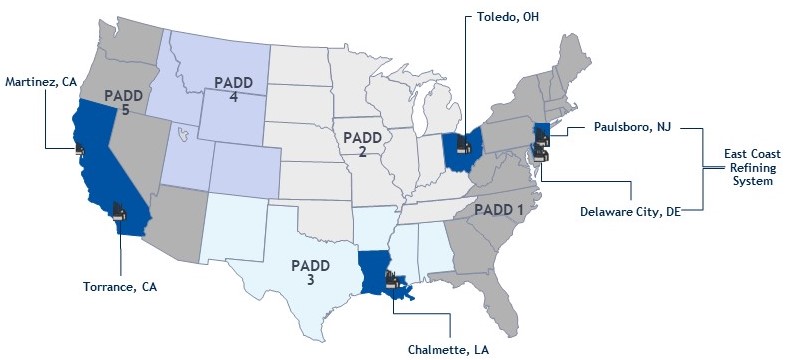
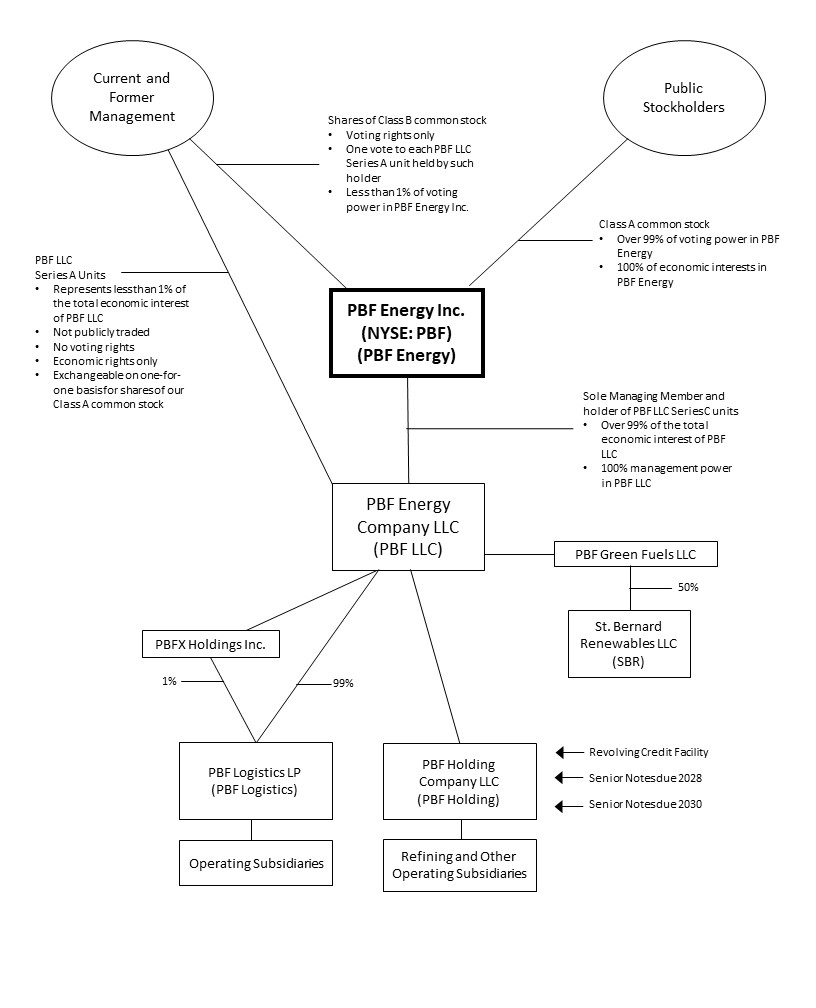
ITEM 1. BUSINESS Overview and Corporate Structure We are one of the largest independent petroleum refiners and suppliers of unbranded transportation fuels, heating oil, petrochemical feedstocks, lubricants and other petroleum products in the United States. We sell our products throughout the Northeast, Midwest, Gulf Coast and West Coast of the United States, as well as in other regions of the United States, Canada and Mexico and are able to ship products to other international destinations. We own and operate six domestic oil refineries and related assets and own a 50% interest in a biorefinery co-located with the Chalmette refinery in Louisiana (the "Renewable Diesel Facility") through our SBR equity method investment. Our refineries have a combined processing capacity, known as throughput, of approximately 1,000,000 bpd, and a weighted-average Nelson Complexity Index of 12.7 based on current operating conditions. The complexity and throughput capacity of our refineries are subject to change dependent upon configuration changes we make to respond to market conditions, as well as a result of investments made to improve our facilities and maintain compliance with environmental and governmental regulations. We operate in two reportable business segments: Refining and Logistics. Our six oil refineries are all engaged in the refining of crude oil and other feedstocks into petroleum products, and represent the Refining segment. PBFX operates certain logistical assets such as crude oil and refined products terminals, pipelines, and storage facilities, which represent the Logistics segment. PBF Energy is a holding company whose primary asset is a controlling equity interest in PBF LLC. We are the sole managing member of PBF LLC and operate and control all of the business and affairs of PBF LLC. We consolidate the financial results of PBF LLC and its subsidiaries and record a noncontrolling interest in our consolidated financial statements representing the economic inter