Frontier Group Holdings, Inc. Files 2023 Annual Report on Form 10-K
Ticker: ULCC · Form: 10-K · Filed: Feb 20, 2024 · CIK: 1670076
Sentiment: neutral
Topics: Frontier Airlines, 10-K Filing, Annual Report, Air Transportation, Financials
TL;DR
<b>Frontier Group Holdings, Inc. has filed its annual report for the fiscal year ended December 31, 2023.</b>
AI Summary
Frontier Group Holdings, Inc. (ULCC) filed a Annual Report (10-K) with the SEC on February 20, 2024. Frontier Group Holdings, Inc. filed its 2023 Form 10-K on February 20, 2024. The filing covers the fiscal year ending December 31, 2023. The company's principal business is scheduled air transportation. Frontier Group Holdings, Inc. is incorporated in Delaware. The company's principal executive offices are located in Denver, Colorado.
Why It Matters
For investors and stakeholders tracking Frontier Group Holdings, Inc., this filing contains several important signals. This 10-K filing provides a comprehensive overview of Frontier's financial performance, operational activities, and strategic outlook for the past fiscal year. Investors and analysts can use this report to assess the company's financial health, understand its business model, and evaluate potential risks and opportunities.
Risk Assessment
Risk Level: medium — Frontier Group Holdings, Inc. shows moderate risk based on this filing. The airline industry is highly competitive and subject to significant economic and operational risks, including fuel price volatility and regulatory changes, which could impact Frontier's financial performance.
Analyst Insight
Review the detailed financial statements and risk factors in the 10-K to understand Frontier's performance and outlook in the current economic climate.
Key Numbers
- 2023-12-31 — Fiscal Year End (Conformed Period of Report)
- 2024-02-20 — Filing Date (Filed As Of Date)
- 4512 — Standard Industrial Classification (SIC Code for Air Transportation, Scheduled)
Key Players & Entities
- Frontier Group Holdings, Inc. (company) — Filer
- Denver (location) — Business Address City
- CO (location) — Business Address State
- 80239 (location) — Business Address Zip
- 4545 Airport Way (location) — Business Address Street 1
- DE (location) — State of Incorporation
FAQ
When did Frontier Group Holdings, Inc. file this 10-K?
Frontier Group Holdings, Inc. filed this Annual Report (10-K) with the SEC on February 20, 2024.
What is a 10-K filing?
A 10-K is a comprehensive annual financial report required by the SEC, covering audited financials, business operations, risk factors, and management discussion. This particular 10-K was filed by Frontier Group Holdings, Inc. (ULCC).
Where can I read the original 10-K filing from Frontier Group Holdings, Inc.?
You can access the original filing directly on the SEC's EDGAR system. The filing is publicly available and includes all exhibits and attachments submitted by Frontier Group Holdings, Inc..
What are the key takeaways from Frontier Group Holdings, Inc.'s 10-K?
Frontier Group Holdings, Inc. filed this 10-K on February 20, 2024. Key takeaways: Frontier Group Holdings, Inc. filed its 2023 Form 10-K on February 20, 2024.. The filing covers the fiscal year ending December 31, 2023.. The company's principal business is scheduled air transportation..
Is Frontier Group Holdings, Inc. a risky investment based on this filing?
Based on this 10-K, Frontier Group Holdings, Inc. presents a moderate-risk profile. The airline industry is highly competitive and subject to significant economic and operational risks, including fuel price volatility and regulatory changes, which could impact Frontier's financial performance.
What should investors do after reading Frontier Group Holdings, Inc.'s 10-K?
Review the detailed financial statements and risk factors in the 10-K to understand Frontier's performance and outlook in the current economic climate. The overall sentiment from this filing is neutral.
How does Frontier Group Holdings, Inc. compare to its industry peers?
Frontier Group Holdings, Inc. operates in the scheduled air transportation industry, a sector characterized by high fixed costs, intense competition, and sensitivity to economic conditions.
Are there regulatory concerns for Frontier Group Holdings, Inc.?
As an airline, Frontier is subject to extensive regulation by the U.S. Department of Transportation and the Federal Aviation Administration, covering safety, operations, and consumer protection.
Industry Context
Frontier Group Holdings, Inc. operates in the scheduled air transportation industry, a sector characterized by high fixed costs, intense competition, and sensitivity to economic conditions.
Regulatory Implications
As an airline, Frontier is subject to extensive regulation by the U.S. Department of Transportation and the Federal Aviation Administration, covering safety, operations, and consumer protection.
What Investors Should Do
- Analyze Frontier's revenue streams and cost structure for the fiscal year 2023.
- Examine the company's liquidity and debt levels as presented in the financial statements.
- Review any disclosed risk factors related to operational challenges or market conditions.
Key Dates
- 2023-12-31: Fiscal Year End — End of the reporting period for the 10-K.
- 2024-02-20: Filing Date — Date the 10-K was officially filed with the SEC.
Year-Over-Year Comparison
This filing is the annual report for the fiscal year ended December 31, 2023, providing updated financial and operational information compared to previous filings.
Filing Stats: 4,404 words · 18 min read · ~15 pages · Grade level 16.1 · Accepted 2024-02-20 16:07:34
Key Financial Figures
- $0.001 — ange on which registered Common Stock, $0.001 par value ULCC The Nasdaq Stock Market
- $609 million — twork. As of December 31, 2023, we had $609 million of cash and cash equivalents, and our c
- $312 million — ated Financial Statements — 8. Debt"): $312 million of the available $365 million under our
- $365 million — Debt"): $312 million of the available $365 million under our pre-delivery deposit ("PDP")
- $80 million — h Citibank ("PDP Financing Facility"); $80 million from our pre-purchased miles facility;
- $66 million — from our pre-purchased miles facility; $66 million in unsecured loans as part of our parti
- $16 million — ic Security Act (the "CARES Act"); and $16 million under our floating rate building note.
- $0.01 — ified period of time for a base fare of $0.01 per flight, subject to certain restrict
- $12.80 — ed increase our ancillary revenues from $12.80 per passenger in 2013 to $76.51 in 2023
- $76.51 — es from $12.80 per passenger in 2013 to $76.51 in 2023. Our other revenues also includ
- $19 — offer promotional one-way base fares of $19. 8 Our principal marketing tools are
Filing Documents
- fron-20231231.htm (10-K) — 2345KB
- frontier-ex102dformofres.htm (EX-10.2D) — 27KB
- frontier-ex106bamendment.htm (EX-10.6B) — 14KB
- frontier-ex107employment.htm (EX-10.7) — 15KB
- frontier-ex1010employmen.htm (EX-10.10) — 2KB
- frontier-ex1040xfifthare.htm (EX-10.40) — 31KB
- frontier-ex191insidertra.htm (EX-19.1) — 24KB
- ex211listofsubsidiariesq423.htm (EX-21.1) — 4KB
- ex231consentofindependentr.htm (EX-23.1) — 3KB
- ex311q423.htm (EX-31.1) — 9KB
- ex312q423.htm (EX-31.2) — 9KB
- ex321q423.htm (EX-32.1) — 5KB
- ex322q423.htm (EX-32.2) — 5KB
- frontier-ex971policyforr.htm (EX-97.1) — 13KB
- fron-20231231_g1.jpg (GRAPHIC) — 91KB
- fron-20231231_g2.jpg (GRAPHIC) — 252KB
- fron-20231231_g3.jpg (GRAPHIC) — 98KB
- frontier-ex1010employmen001.jpg (GRAPHIC) — 228KB
- frontier-ex1010employmen002.jpg (GRAPHIC) — 283KB
- frontier-ex1010employmen003.jpg (GRAPHIC) — 284KB
- frontier-ex1010employmen004.jpg (GRAPHIC) — 248KB
- frontier-ex1010employmen005.jpg (GRAPHIC) — 54KB
- frontier-ex102dformofres001.jpg (GRAPHIC) — 236KB
- frontier-ex102dformofres002.jpg (GRAPHIC) — 235KB
- frontier-ex102dformofres003.jpg (GRAPHIC) — 240KB
- frontier-ex102dformofres004.jpg (GRAPHIC) — 279KB
- frontier-ex102dformofres005.jpg (GRAPHIC) — 242KB
- frontier-ex102dformofres006.jpg (GRAPHIC) — 273KB
- frontier-ex102dformofres007.jpg (GRAPHIC) — 188KB
- frontier-ex1040xfifthare001.jpg (GRAPHIC) — 248KB
- frontier-ex1040xfifthare002.jpg (GRAPHIC) — 263KB
- frontier-ex1040xfifthare003.jpg (GRAPHIC) — 247KB
- frontier-ex1040xfifthare004.jpg (GRAPHIC) — 229KB
- frontier-ex1040xfifthare005.jpg (GRAPHIC) — 274KB
- frontier-ex1040xfifthare006.jpg (GRAPHIC) — 250KB
- frontier-ex1040xfifthare007.jpg (GRAPHIC) — 249KB
- frontier-ex1040xfifthare008.jpg (GRAPHIC) — 211KB
- frontier-ex1040xfifthare009.jpg (GRAPHIC) — 111KB
- frontier-ex1040xfifthare010.jpg (GRAPHIC) — 73KB
- frontier-ex1040xfifthare011.jpg (GRAPHIC) — 27KB
- frontier-ex1040xfifthare012.jpg (GRAPHIC) — 28KB
- frontier-ex1040xfifthare013.jpg (GRAPHIC) — 27KB
- frontier-ex106bamendment001.jpg (GRAPHIC) — 211KB
- frontier-ex106bamendment002.jpg (GRAPHIC) — 275KB
- frontier-ex106bamendment003.jpg (GRAPHIC) — 264KB
- frontier-ex106bamendment004.jpg (GRAPHIC) — 170KB
- frontier-ex106bamendment005.jpg (GRAPHIC) — 48KB
- frontier-ex107employment001.jpg (GRAPHIC) — 246KB
- frontier-ex107employment002.jpg (GRAPHIC) — 260KB
- frontier-ex107employment003.jpg (GRAPHIC) — 272KB
- frontier-ex107employment004.jpg (GRAPHIC) — 237KB
- frontier-ex107employment005.jpg (GRAPHIC) — 47KB
- frontier-ex191insidertra001.jpg (GRAPHIC) — 252KB
- frontier-ex191insidertra002.jpg (GRAPHIC) — 242KB
- frontier-ex191insidertra003.jpg (GRAPHIC) — 212KB
- frontier-ex191insidertra004.jpg (GRAPHIC) — 251KB
- frontier-ex191insidertra005.jpg (GRAPHIC) — 188KB
- frontier-ex191insidertra006.jpg (GRAPHIC) — 215KB
- frontier-ex191insidertra007.jpg (GRAPHIC) — 206KB
- frontier-ex191insidertra008.jpg (GRAPHIC) — 233KB
- frontier-ex191insidertra009.jpg (GRAPHIC) — 50KB
- frontier-ex971policyforr001.jpg (GRAPHIC) — 226KB
- frontier-ex971policyforr002.jpg (GRAPHIC) — 247KB
- frontier-ex971policyforr003.jpg (GRAPHIC) — 211KB
- frontier-ex971policyforr004.jpg (GRAPHIC) — 251KB
- 0001670076-24-000021.txt ( ) — 25664KB
- fron-20231231.xsd (EX-101.SCH) — 92KB
- fron-20231231_cal.xml (EX-101.CAL) — 116KB
- fron-20231231_def.xml (EX-101.DEF) — 361KB
- fron-20231231_lab.xml (EX-101.LAB) — 1009KB
- fron-20231231_pre.xml (EX-101.PRE) — 653KB
- fron-20231231_htm.xml (XML) — 1365KB








Risk Factors
Item 1A. Risk Factors 22
Unresolved Staff Comments
Item 1B. Unresolved Staff Comments 54
Cybersecurity
Item 1C. Cybersecurity 54
Properties
Item 2. Properties 56
Legal Proceedings
Item 3. Legal Proceedings 57
Mine Safety Disclosure
Item 4. Mine Safety Disclosure 57 Part II
Market for Registrant's Common Equity, Related Stockholder Matters and Issuer Purchases of Equity Securities
Item 5. Market for Registrant's Common Equity, Related Stockholder Matters and Issuer Purchases of Equity Securities 57
[Reserved]
Item 6. [Reserved] 58
Management's Discussion and Analysis of Financial Condition and Results of Operations
Item 7. Management's Discussion and Analysis of Financial Condition and Results of Operations 59
Quantitative and Qualitative Disclosure About Market Risk
Item 7A. Quantitative and Qualitative Disclosure About Market Risk 80
Financial Statements and Supplementary Data
Item 8. Financial Statements and Supplementary Data 81
Changes in and Disagreements with Accountants on Accounting and Financial Disclosure
Item 9. Changes in and Disagreements with Accountants on Accounting and Financial Disclosure 120
Controls and Procedures
Item 9A. Controls and Procedures 120
Other Information
Item 9B. Other Information 121
Disclosure Regarding Foreign Jurisdictions that Prevent Inspections
Item 9C. Disclosure Regarding Foreign Jurisdictions that Prevent Inspections 121 Part III
Directors, Executive Officers and Corporate Governance
Item 10. Directors, Executive Officers and Corporate Governance 121
Executive Compensation
Item 11. Executive Compensation 121
Security Ownership of Certain Beneficial Owners and Management and Related Stockholder Matters
Item 12. Security Ownership of Certain Beneficial Owners and Management and Related Stockholder Matters 121
Certain Relationships and Related Transactions, and Director Independence
Item 13. Certain Relationships and Related Transactions, and Director Independence 121
Principal Accountant Fees and Services
Item 14. Principal Accountant Fees and Services 122 Part IV
Exhibits and Financial Statement Schedules
Item 15. Exhibits and Financial Statement Schedules 123
Form 10-K Summary
Item 16. Form 10-K Summary 131
Signatures
Signatures 132 1 Cautionary Statement Regarding Forward-Looking Statements Certain statements in this Annual Report on Form 10-K should be considered forward-looking statements within the meaning of Section 27A of the Securities Act of 1933, as amended (the "Securities Act"), and Section 21E of the Securities Exchange Act of 1934, as amended (the "Exchange Act"), and the Private Securities Litigation Reform Act of 1995. These forward-looking statements are based on our current expectations and beliefs with respect to certain current and future events and anticipated financial and operating performance. Words such as "may," "might," "will," "should," "could," "would," "expect," "intends," "plan," "anticipate," "believe," "estimate," "project," "targets," "predict," "potential," and similar expressions intended to identify forward-looking statements. Additionally, forward-looking statements include statements that do not relate solely to historical facts, such as statements which identify uncertainties or trends, discuss the possible future effects of current known trends or uncertainties, or which indicate that the future effects of known trends or uncertainties cannot be predicted, guaranteed or assured. Forward-looking statements are based upon current plans, expectations and beliefs involving risks and uncertainties. Our actual results may differ materially from those anticipated in these forward-looking statements as a result of various factors, including those set forth in Part I, Item 1A, "Risk Factors", Part II, Item 7, "Management's Discussion and Analysis of Financial Condition and Results of Operations" and other factors set forth from time to time under the sections captioned "Risk Factors" in our reports and other documents filed with the Securities and Exchange Commission (the "SEC"). Furthermore, such forward-looking statements speak only as of the date of this report. Except as required by law, we undertake no obligation to update any forward-loo
BUSINESS
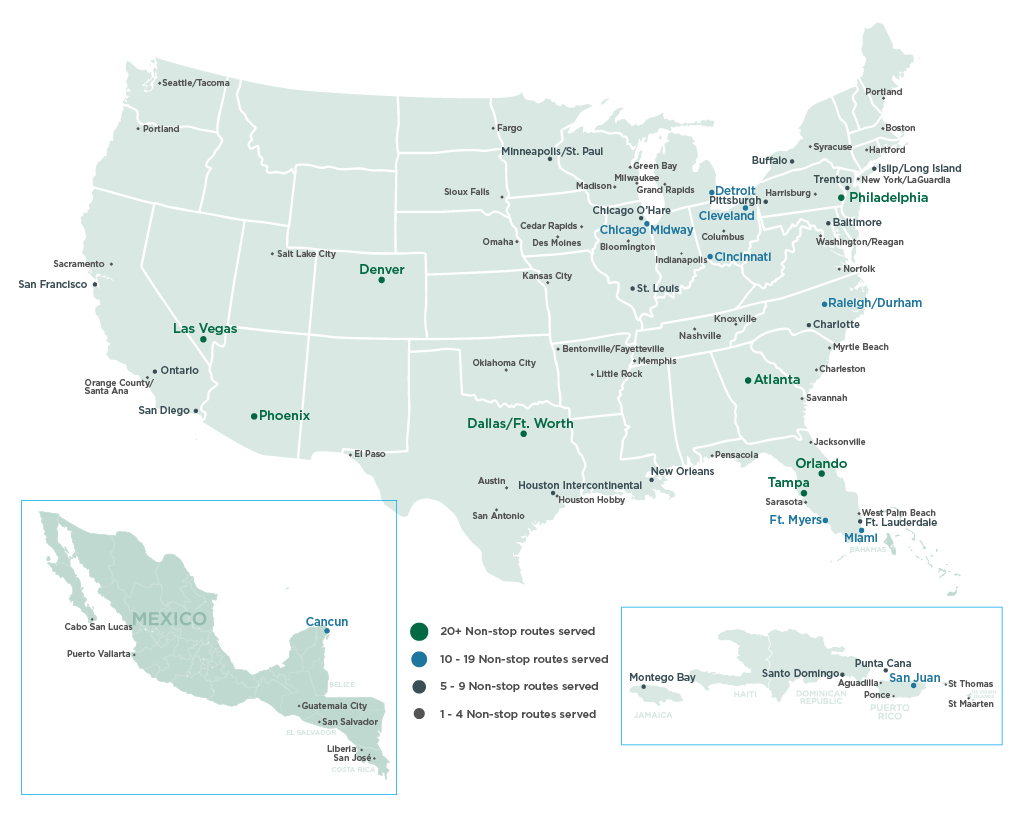
ITEM 1. BUSINESS Overview Frontier Airlines, Inc. ("Frontier") is an ultra low-cost carrier whose business strategy is focused on Low Fares Done Right . We are headquartered in Denver, Colorado and offer flights throughout the United States and to select near international destinations in the Americas. As of December 31, 2023, we had a fleet of 136 Airbus single-aisle aircraft, consisting of 8 A320ceos, 82 A320neos, 21 A321ceos and 25 A321neos. Our unique strategy is underpinned by our low-cost structure and superior low-fare brand. Our Business Model Our business model is based on our unique Low Fares Done Right strategy. While our strategy is similar to the business models utilized by other ULCCs, including with respect to low-cost structure, low fares and flexible optional services, we believe Low Fares Done Right differentiates us from other ULCCs as a result of our focus on delivering a family-friendly customer experience with a more upscale look and feel than traditionally experienced on ULCCs globally. From the perspective of our customers, our business model provides a product offering that combines low base fares with dependable customer service, a customer-friendly digital platform, a rewarding frequent flyer program, a modern fleet, comfortable cabin seating, flexible optional services and operational integrity. Our Competitive Strengths & Our Business Strategy— Low Fares Done Right Our goal is to offer the most attractive option for air travel with a compelling combination of value, product and service, and, in doing so, to grow profitably and enhance our position among U.S. airlines. Through the key elements of our business strategy, we seek to achieve: Low Unit Costs. Our low-cost structure, built around low aircraft ownership cost, fuel efficiency and low operational costs, is our key strategic advantage. We intend to strengthen and maintain our low unit costs, including by: maintaining high utilization levels; utilizing new generation, fuel-