Asana, Inc. Files 2024 Annual Report on Form 10-K
Ticker: ASAN · Form: 10-K · Filed: 2024-03-14T00:00:00.000Z
Sentiment: neutral
Topics: Asana, 10-K, Annual Report, Fiscal Year 2024, Software
TL;DR
<b>Asana, Inc. has submitted its annual 10-K filing for the fiscal year ending January 31, 2024.</b>
AI Summary
Asana, Inc. (ASAN) filed a Annual Report (10-K) with the SEC on March 14, 2024. Asana, Inc. filed its 10-K report for the fiscal year ending January 31, 2024. The filing covers the period from February 1, 2023, to January 31, 2024. The company's principal business address is 633 Folsom Street, Suite 100, San Francisco, CA 94107. Asana, Inc. is incorporated in Delaware. The Standard Industrial Classification code for Asana is 7372 (SERVICES-PREPACKAGED SOFTWARE).
Why It Matters
For investors and stakeholders tracking Asana, Inc., this filing contains several important signals. This 10-K filing provides a comprehensive overview of Asana's financial performance, business operations, and risk factors for the fiscal year 2024. Investors and stakeholders can use this report to assess the company's financial health, strategic direction, and potential future performance.
Risk Assessment
Risk Level: — Asana, Inc. shows moderate risk based on this filing. The filing is a standard 10-K annual report, which typically contains routine financial and operational information without immediate, significant market-moving news.
Analyst Insight
Review the detailed financial statements and risk factors within the 10-K to understand Asana's performance and outlook for the upcoming fiscal year.
Key Numbers
- 2024-01-31 — Fiscal Year End (The end date of the reporting period.)
- 2024-03-14 — Filing Date (The date the 10-K was filed with the SEC.)
- 001-39495 — SEC File Number (The SEC's file number for Asana, Inc.)
Key Players & Entities
- Asana, Inc. (company) — Filer name
- 2024-01-31 (date) — Fiscal year end date
- 2024-03-14 (date) — Filing date
- 633 Folsom Street, Suite 100, San Francisco, CA 94107 (address) — Business address
- DE (state) — State of incorporation
- 7372 (sic_code) — Standard Industrial Classification code
FAQ
When did Asana, Inc. file this 10-K?
Asana, Inc. filed this Annual Report (10-K) with the SEC on March 14, 2024.
What is a 10-K filing?
A 10-K is a comprehensive annual financial report required by the SEC, covering audited financials, business operations, risk factors, and management discussion. This particular 10-K was filed by Asana, Inc. (ASAN).
Where can I read the original 10-K filing from Asana, Inc.?
You can access the original filing directly on the SEC's EDGAR system. The filing is publicly available and includes all exhibits and attachments submitted by Asana, Inc..
What are the key takeaways from Asana, Inc.'s 10-K?
Asana, Inc. filed this 10-K on March 14, 2024. Key takeaways: Asana, Inc. filed its 10-K report for the fiscal year ending January 31, 2024.. The filing covers the period from February 1, 2023, to January 31, 2024.. The company's principal business address is 633 Folsom Street, Suite 100, San Francisco, CA 94107..
Is Asana, Inc. a risky investment based on this filing?
Based on this 10-K, Asana, Inc. presents a moderate-risk profile. The filing is a standard 10-K annual report, which typically contains routine financial and operational information without immediate, significant market-moving news.
What should investors do after reading Asana, Inc.'s 10-K?
Review the detailed financial statements and risk factors within the 10-K to understand Asana's performance and outlook for the upcoming fiscal year. The overall sentiment from this filing is neutral.
How does Asana, Inc. compare to its industry peers?
Asana operates in the pre-packaged software industry, providing a work management platform.
Are there regulatory concerns for Asana, Inc.?
The filing is made in accordance with the Securities Exchange Act of 1934.
Industry Context
Asana operates in the pre-packaged software industry, providing a work management platform.
Regulatory Implications
The filing is made in accordance with the Securities Exchange Act of 1934.
What Investors Should Do
- Analyze the financial statements for revenue, net income, and cash flow.
- Review the risk factors section for potential challenges and uncertainties.
- Examine management's discussion and analysis for insights into business strategy and outlook.
Key Dates
- 2024-01-31: Fiscal Year End — Marks the end of the reporting period for the 10-K.
- 2024-03-14: Filing Date — The date Asana, Inc. officially submitted its 10-K to the SEC.
Year-Over-Year Comparison
This is the initial 10-K filing for the fiscal year ending January 31, 2024, following the previous fiscal year's report.
Filing Stats: 4,543 words · 18 min read · ~15 pages · Grade level 15.5 · Accepted 2024-03-14 16:14:08
Key Financial Figures
- $0.00001 — hich registered Class A Common Stock, $0.00001 par value per share ASAN New York Sto
- $5,000 — tion rate within organizations spending $5,000 or more with us on an annualized basis
- $100,000 — tion rate within organizations spending $100,000 or more with us on an annualized basis
Filing Documents
- asan-20240131.htm (10-K) — 1973KB
- exhibit211-asanaincsubsidi.htm (EX-21.1) — 8KB
- exhibit231-consentofindepe.htm (EX-23.1) — 2KB
- exhibit311-ceo302certifica.htm (EX-31.1) — 10KB
- exhibit312-cfo302certifica.htm (EX-31.2) — 10KB
- exhibit321-ceocfo906certif.htm (EX-32.1) — 6KB
- exhibit971clawbackpolicy.htm (EX-97.1) — 36KB
- asan-20240131_g1.jpg (GRAPHIC) — 245KB
- asan-20240131_g2.jpg (GRAPHIC) — 184KB
- asan-20240131_g3.jpg (GRAPHIC) — 86KB
- 0001477720-24-000011.txt ( ) — 10947KB
- asan-20240131.xsd (EX-101.SCH) — 52KB
- asan-20240131_cal.xml (EX-101.CAL) — 106KB
- asan-20240131_def.xml (EX-101.DEF) — 256KB
- asan-20240131_lab.xml (EX-101.LAB) — 768KB
- asan-20240131_pre.xml (EX-101.PRE) — 556KB
- asan-20240131_htm.xml (XML) — 1378KB

Business
Item 1. Business 6
Risk Factors
Item 1A. Risk Factors 23
Unresolved Staff Comments
Item 1B. Unresolved Staff Comments 54 Item IC. Cybersecurity 54
Properties
Item 2. Properties 55
Legal Proceedings
Item 3. Legal Proceedings 56
Mine Safety Disclosures
Item 4. Mine Safety Disclosures 56 Part II 57
Market for Registrant's Common Equity, Related Stockholder Matters and Issuer Purchases of Equity Securities
Item 5. Market for Registrant's Common Equity, Related Stockholder Matters and Issuer Purchases of Equity Securities 57
[ Reserve d ]
Item 6. [ Reserve d ] 58
Management's Discussion and Analysis of Financial Condition and Results of Operations
Item 7. Management's Discussion and Analysis of Financial Condition and Results of Operations 59
Quantitative and Qualitative Disclosures about Market Risk
Item 7A. Quantitative and Qualitative Disclosures about Market Risk 75
Financial Statements and Supplementary Data
Item 8. Financial Statements and Supplementary Data 76
Changes in and Disagreements With Accountants on Accounting and Financial Disclosures
Item 9. Changes in and Disagreements With Accountants on Accounting and Financial Disclosures 110
Controls and Procedures
Item 9A. Controls and Procedures 110
Other Information
Item 9B. Other Information 111
Disclosure Regarding Foreign Jurisdictions That Prevent Inspections
Item 9C. Disclosure Regarding Foreign Jurisdictions That Prevent Inspections. 111 Part III 112
Directors, Executive Officers and Corporate Governance
Item 10. Directors, Executive Officers and Corporate Governance 112
Executive Compensation
Item 11. Executive Compensation 113
Security Ownership of Certain Beneficial Owner and Management and Related Stockholder Matters
Item 12. Security Ownership of Certain Beneficial Owner and Management and Related Stockholder Matters 113
Certain Relationships and Related Transactions, and Director Independence
Item 13. Certain Relationships and Related Transactions, and Director Independence 114
Principal Accounting Fees and Services
Item 14. Principal Accounting Fees and Services 114 Part IV 115
Exhibits and Financial Statement Schedules
Item 15. Exhibits and Financial Statement Schedules 115
Form 10-K Summary
Item 16. Form 10-K Summary 117
Signatures
Signatures 118 ______________________ 2 SPECIAL NOTE REGARDING FORWARD-LOOKING STATEMENTS This Annual Report on Form 10-K contains forward-looking statements within the meaning of Section 27A of the Securities Act of 1933, as amended (the "Securities Act"), and Section 21E of the Securities Exchange Act of 1934, as amended (the "Exchange Act"), which statements involve substantial risk and uncertainties. All statements other than statements of historical facts contained in this Annual Report on Form 10-K, including statements regarding our future results of operations or financial condition; business strategy and plans; and objectives of management for future operations are forward-looking statements. In some cases, you can identify forward-looking statements because they contain words such as "anticipate," "believe," "contemplate," "continue," "could," "estimate," "expect," "intend," "may," "plan," "potential," "predict," "project," "should," "target," "will," or "would" or the negative of these words or other similar terms or expressions. Forward-looking statements contained in this Annual Report on Form 10-K include, but are not limited to, statements about: our ability to grow or maintain our dollar-based net retention rate, expand usage of our platform within organizations, and sell subscriptions to our platform; our ability to convert individuals, teams, and organizations on our free and trial versions into paying customers; the timing and success of new features, integrations, capabilities, and enhancements by us, or by our competitors to their products, including the successful integration of artificial intelligence ("AI"), or any other changes in the competitive landscape of our market; our ability to achieve widespread acceptance and use of our platform; growth in the work management market; the amount and timing of operating expenses and capital expenditures, as well as entry into operating leases, that we may incur to maintain and expand our busi
Business
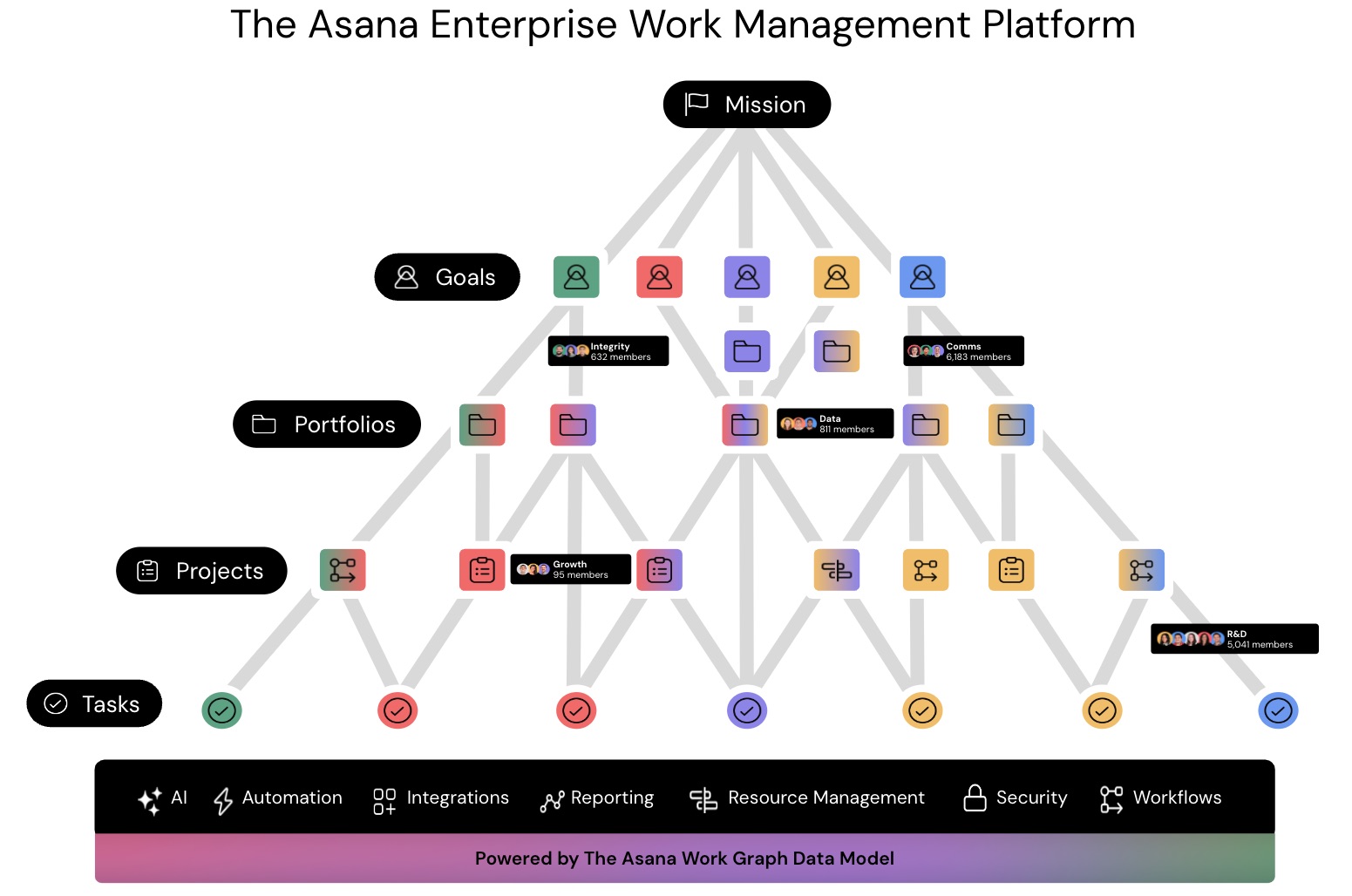
Item 1. Business Overview Asana is a leading work management software platform with an enterprise focus that helps organizations set and track goals, drive strategic initiatives, and manage work in one place. Over 150,000 paying customers us e Asana to automate complex operational workflows like product launches and employee onboarding, resource planning, tracking company-wide strategic initiatives and more. Our secure and scalable platform with AI-powered features adds structure to unstructured work, creating clarity, accountability, and impact for everyone within an organization—executives, department heads, team leads, and individuals—so everyone understands exactly who is doing what, by when, and why. Background Asana was created because our co-founders experienced firsthand the coordination challenges of a growing company. Instead of spending time on work that generated results, they were spending time in status meetings and long email threads trying to coordinate work effectively to achieve their objectives, a pain universal to organizations. As there were no products in the market that adequately addressed this, our co-founders were inspired to create Asana to solve this problem for the world's teams. Since inception, Asana has registered millions of users in over 200 countries and territories. Customers rely on Asana to manage everything from goal setting and tracking to capacity planning, product launches, and driving digital transformation. With Asana, users experience higher productivity and engagement, which has led to rapid adoption across teams, departments, and organizations. As of January 31, 2024, we had over 3 million paid users. How Asana Helps Organizations Teams are spending too much time coordinating work and not enough time doing the jobs they were hired for. Asana is a leading work management platform that brings cross-functional teams together, creates a system of record across initiatives, and across levels of an organization so that